What is black hole image?What is black hole theory?What does the black hole mean?What are the two types of black holes?
Saturday, January 11, 2020
Black hole
BLACK HOLE DESCRIPTIONS A black hole is a region of spacetime exhibiting gravitational acceleration so strong that nothing—no particles or even electromagnetic radiation such as light—can escape from it. The theory of general relativity predicts that a sufficiently compact mass can deform spacetime to form ablack hole.
DISCOVERY The discovery of neutron stars by Jocelyn Bell Burnell in 1967 sparked interest in gravitationally collapsed compact objects as a possible astrophysical reality. ... By absorbing other stars and merging with other black holes, supermassiveblack holes of millions of solar masses ( M ☉) may form.
Anatomy of a Black Hole
This artist’s impression depicts a rapidly spinning supermassive black hole surrounded by an accretion disc. This thin disc of rotating material consists of the leftovers of a Sun-like star which was ripped apart by the tidal forces of the black hole. The black hole is labelled, showing the anatomy of this fascinating object.
Black Holes
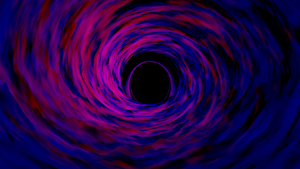
Simulation of hot gas surrounding and falling into a black hole. (Credit: NASA's Goddard Space Flight Center/J. Schnittman, J. Krolik (JHU) and S. Noble (RIT))
The simplest definition of a black hole is an object that is so dense that not even light can escape its surface. But how does that happen?
The concept of a black hole can be understood by thinking about how fast something needs to move to escape the gravity of another object – this is called the escape velocity. Formally, escape velocity is the speed an object must attain to "break free" of the gravitational attraction of another body.
There are two things that affect the escape velocity – the mass of object and the distance to the center of that object. For example, a rocket must accelerate to 11.2 km/s in order to escape Earth's gravity. If, instead, that rocket was on a planet with the same mass as Earth but half the diameter, the escape velocity would be 15.8 km/s. Even though the mass is the same, the escape velocity is greater, because the object is smaller (and more dense).
What if we made the size of the object even smaller? If we squished the Earth's mass into a sphere with a radius of 9 mm, the escape velocity would be the speed of light. Just a wee-bit smaller, and the escape velocity is greater than the speed of light. But the speed of light is the cosmic speed limit, so it would be impossible to escape that tiny sphere, if you got close enough.
The radius at which a mass has an escape velocity equal to the speed of light is called the Schwarzschild radius. Any object that is smaller than its Schwarzschild radius is a black hole – in other words, anything with an escape velocity greater than the speed of light is a black hole. For something the mass of our sun would need to be squeezed into a volume with a radius of about 3 km.
MORE ABOUT BLACK HOLE
BLACK HOLES ARE points in space that are so dense they create deep gravity sinks. Beyond a certain region, not even light can escape the powerful tug of a black hole's gravity. And anything that ventures too close—be it star, planet, or spacecraft—will be stretched and compressed like putty in a theoretical process aptly known as spaghettification.
There are four types of black holes: stellar, intermediate, supermassive, and miniature. The most commonly known way a black hole forms is by stellar death. As stars reach the ends of their lives, most will inflate, lose mass, and then cool to form white dwarfs. But the largest of these fiery bodies, those at least 10 to 20 times as massive as our own sun, are destined to become either super-dense neutron stars or so-called stellar-mass black holes.
BLACK HOLE WINDA composite x-ray/optical image of the active NGC 1068 galaxy reveals an enormous plume of hot gas emanating from the supermassive black hole at the galaxy's center. Scientists think the shape and speed of the plume, which moves at about 1 million miles an hour (1.6 million kilometers an hour), are caused by the funneling effect of a doughnut-shaped ring of cooler gas and dust that surrounds the black hole.PHOTOGRAPH COURTESY NASA/CXC/MIT/UCSB/P. OGLE ET AL./STSCI/A. CAPETTI ET AL.
UNEXPECTED X-RAYSIn 2000, astronomers studying the A2104 galaxy cluster (in blue) discovered powerful x-rays emanating from several black holes in regions previously thought too old and devoid of gas to create such radiation. They had expected to find perhaps one such x-ray source in the area, but instead found six. The discovery, made using the Chandra X-ray Observatory, changed many of the assumptions scientists had made about the life cycles of galaxies and black holes.PHOTOGRAPH COURTESY NASA/CXC/OCIW/P. MARTINI ET AL.
INTERMEDIATE-MASS BLACK HOLEAstronomers think the object shown in this Chandra X-ray Observatory image (in box) may be an elusive intermediate-mass black hole. Located about 32 million light-years from Earth in the Messier 74 galaxy (M74), this object emits periodic bursts of x-rays at a rate that suggests it is much larger than a stellar-mass black hole but significantly smaller than the supermassive black holes found at the centers of galaxies. Few such middling black holes have been discovered, and scientists aren't sure how they form.PHOTOGRAPH COURTESY NASA/CXC/U. OF MICHIGAN/J. LIU ET AL./ NOAO/AURA/NSF/T. BOROSON
X-RAY JETAn artist's rendering, made using data collected by the orbiting Chandra X-ray Observatory, shows a quasar galaxy with a jet of high-energy particles extending more than 100,000 light-years from the supermassive black hole at its center. The object, located 12 billion light-years from Earth, is the most distant such jet ever detected. These quasar jets are formed when electrons emitted from a black hole impact with cosmic background radiation left by the big bang, giving astronomers clues
Black Holes
BLACK HOLES ARE points in space that are so dense they create deep gravity sinks. Beyond a certain region, not even light can escape the powerful tug of a black hole's gravity. And anything that ventures too close—be it star, planet, or spacecraft—will be stretched and compressed like putty in a theoretical process aptly known as spaghettification.
There are four types of black holes: stellar, intermediate, supermassive, and miniature. The most commonly known way a black hole forms is by stellar death. As stars reach the ends of their lives, most will inflate, lose mass, and then cool to form white dwarfs. But the largest of these fiery bodies, those at least 10 to 20 times as massive as our own sun, are destined to become either super-dense neutron stars or so-called stellar-mass black holes.
BLACK HOLES 101At the center of our galaxy, a supermassive black hole churns. Learn about the types of black holes, how they form, and how scientists discovered these invisible, yet extraordinary objects in our universe.
In their final stages, enormous stars go out with a bang in massive explosions known as supernovae.Such a burst flings star matter out into space but leaves behind the stellar core. While the star was alive, nuclear fusion created a constant outward push that balanced the inward pull of gravity from the star's own mass. In the stellar remnants of a supernova, however, there are no longer forces to oppose that gravity, so the star core begins to collapse in on itself.
If its mass collapses into an infinitely small point, a black hole is born. Packing all of that bulk—many times the mass of our own sun—into such a tiny point gives black holes their powerful gravitational pull. Thousands of these stellar-mass black holes may lurk within our own Milky Way galaxy.
One black hole is not like the others
Supermassive black holes, predicted by Einstein's general theory of relativity, can have masses equal to billions of suns; these cosmic monsters likely hide at the centers of most galaxies. The Milky Way hosts its own supermassive black hole at its center known as Sagittarius A*(pronounced “ay star”) that is more than four million times as massive as our sun.
The tiniest members of the black hole family are, so far, theoretical. These small vortices of darkness may have swirled to life soon after the universe formed with the big bang, some 13.7 billion years ago, and then quickly evaporated. Astronomers also suspect that a class of objects called intermediate-mass black holes exist in the universe, although evidence for them is so far debatable.
No matter their starting size, black holes can grow throughout their lives, slurping gas and dust from any objects that creep too close. Anything that passes the event horizon, the point at which escape becomes impossible, is in theory destined for spaghettification thanks to a sharp increase in the strength of gravity as you fall into the black hole




No comments:
Post a Comment